
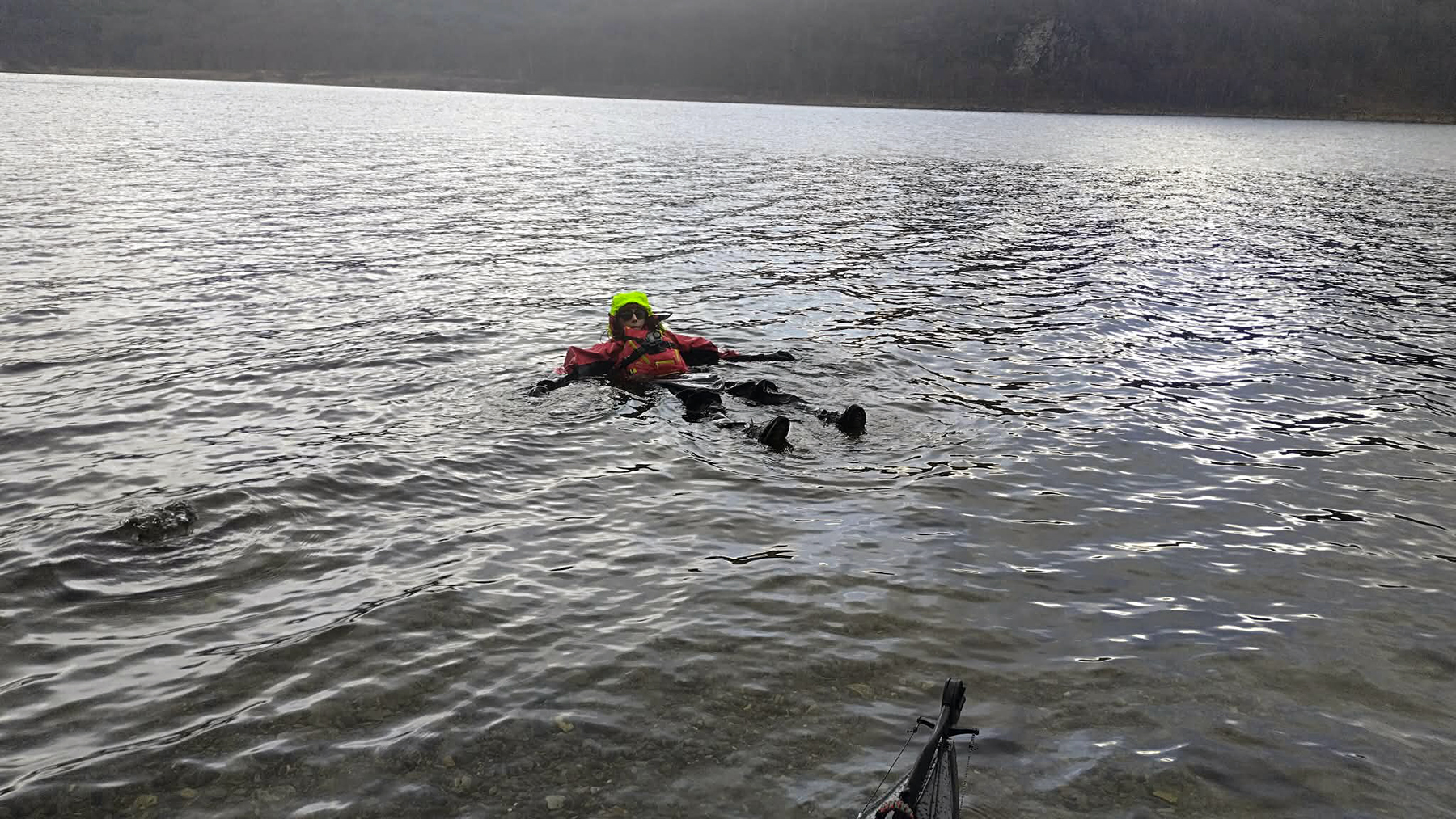
For this review, we wanted to have a look at our relatively new dry suits, that were bought by us on sale at the end of autumn last year. Dry suits that we are still getting to grips with, and that I put to the test last month in the frigid waters of Llyn Dinas on a cold February day.
We knew as we fell in love with kayaking, that we were never going to be the kind of people who hung up our paddles over the winter, but instead we would be looking to paddle all the way through the colder months, when possible (health and weather aside). We’re sticklers for trying to have the right gear, so once we realised we were going to need a dry suit each, we started the hunt for something we could afford.
This is easier said than done. Dry suits are not a once in a lifetime purchase, but unless there are major problems with them, they are usually kept for a very long time. Even rips and tears are actively repaired. This means that they tend to cost quite a bit of money. The less you need to buy something, the more expensive it tends to be. We had thought of perhaps cags, and dry trousers instead, but they can be difficult if you intend to capsize (as in filling up with water, if not sealed properly, difficult). So only a full dry suit would do.
Specifications:
So, we needed to find something to fit our specifications. We wanted a tunnel at the waist, for our spray skirts, and the neck and arm seals/gaskets needed to be neoprene, and not latex. Apparently latex is a better seal, but I am allergic to it, so it had to be neoprene. We did not mind whether it was front or back entry, or whether it was a women’s or a men’s suit, but we preferred it to have some sort of hood, and or face covering (my breathing struggles in very cold air). Lots of the suits on the market were many hundreds of pounds, and while they might have had a self draining pocket here and there, they often ended at the neck, and were very simple. For ages, we just felt stuck.
Then we found Marine Superstore, and their listing for the Yak Strata dry suit. Supposedly it was down from £450, to £229. It was a ‘men’s’ dry suit (with no women’s option), and so had a front zip pocket for toilet time, and it was only available in one colour. It did however have a rear entry with braces (which seemed easier, maybe), enhanced 3-layer breathable 20k material, Cordura reinforced seat and knees giving extra protection when sitting or kneeling, a paddle specific cut with rear stretch panel making moving in your boat easier, reflective safety panels all over, adjustable waist band, wristbands (great for gloves), and ankle bands, and most importantly for my breathing, a built-in storm collar, that I can bring up and around my face to help my breathing in the cold.
There’s also a bright yellow fold away hood, which helps with being seen from a distance. We thought they looked great. We knew dry suits did not insulate, so we each bought one size up, to make sure we can comfortably layer up, underneath, while wearing them.
We have been generally happy with them. Overall they feel very big and clunky when you get them on, but once you tighten the middle, hands and ankles up, it starts to feel a lot more like it fits well. I tend to wear a number of fleeces under mine, with a rash vest occasionally, and every time so far for the bottom half, I have just worn a pair of O’Neill ski pants underneath. So far it has all kept me toasty.
They can be a bit difficult to get on, though. We often share/help each other in the fight to board our dry suits in the house (to save embarrassment outside), and then we wear them in the car all the way to our destination, and quite often, we do the same in reverse. Getting your head, though a neoprene seal that is supposed to be tight on your neck, is quite a struggle. Overall though, while paddling with them, we have had zero issues with movement, getting out of our boats, or paddling, although I do often overheat wearing it, which personally makes me struggle. I am still trying to work out the right ration of layers for any given conditions, but it’s only a slight moan, really. Often we’re extremely warm, while our hands are frozen stiff.
We have only had the chance, however, to try them in the water once. We were at Plas Dinas, which is a small lake in Eryri (Snowdonia), in February this year (2026), and after our paddle had concluded, I asked for some help to get a few feet into the water, and decided to give it a test. I laid down, and instantly floated. I still had my buoyancy aid on, of course, and it was remarkably warm still. I could feel the cold of the lake, but it was very obvious to me straight away, that should I end up in the water, and need rescue, somehow, I would be able to last much longer with the dry suit on, than I would without it.
As I was happily floating, and moving my arms to stop the wind pushing me down the lake, my daughter was taking some images from back on the shore. Then it hit me. A cold sensation down my back, ever so slightly. Immediately, I realised I am letting water in, and think I must have a tear in the suit. While it was cold, it was only a trickle, and even with that, I would be able to last a very long time. My daughter came over to help me out, and as I got up to my feet, the small trickle, was actually a big trickle that was waiting in my arms. It suddenly ran down my arms, down my back, and then down my legs, and I audibly shrieked.
I thought it was rather funny at the time, but we were still confused as to why I might have been letting freezing cold water in. As it turns out, we think that a combination of the zip at the back not being fully, fully closed, was one of the problems, and then I had not properly burped the suit. We usually try and do it at home, but it’s far less efficient, which likely meant there was air in my suit (under pressure in the water), that happily traded places with the water, through the slightly opened zip, when I laid down. Apparently, the correct process to ‘burp’ one’s suit, is to go into the water, which will pressurise the suit, and you can then let the air out, at the neck. We will have to do this next time.
I still wore the dry suit home, calling in at a friend’s house on the way past for a panad. By the time I got home, the wet parts of me were still wet, but they were hot to the touch, and steaming. The suit and layers, had acted sort of like a wetsuit, and had kept me warm. We’re really pleased with this bit of kit, and we would recommend it to anyone. It’s a great price, quality kit, and the features it comes with, can only be found on dry suits that are in the much more expensive price ranges. At the time of writing, it’s still for sale at the price we bought it for.
We are honestly, still wondering what to do with the front zip, though. 🙂
Discover more from Baileys Int' Wild
Subscribe to get the latest posts sent to your email.