
Accessibilty
Parking
Toilets
Access Cost
Geography
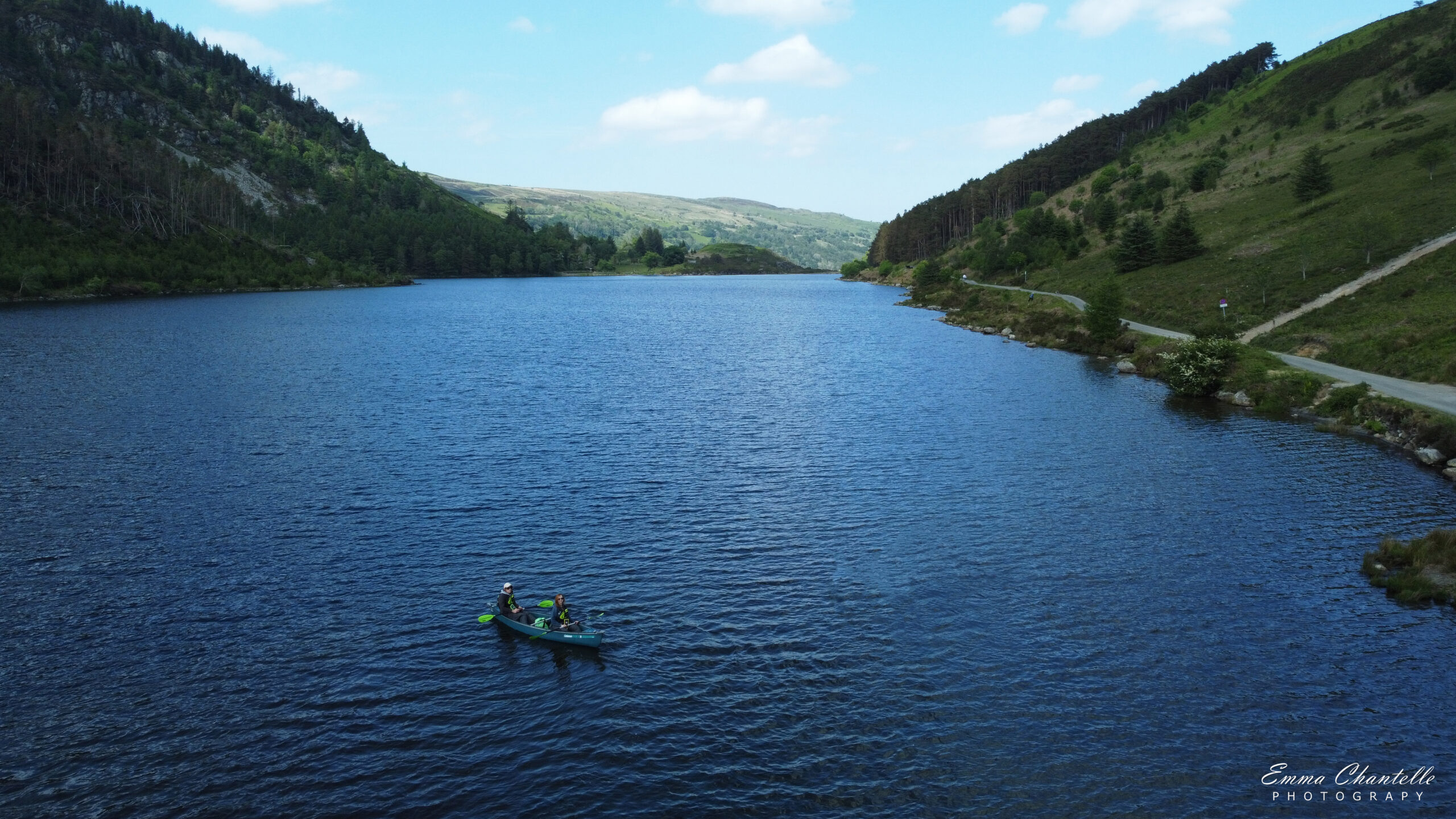
Llyn Geirionydd sits in an upland hollow above the Conwy Valley, surrounded by rounded hills and managed woodland. When you’re at the lake, the landscape feels enclosed but not dramatic. This is not a high, jagged mountain cirque, but rather, a quieter upland basin shaped by glaciation.
The lake is framed by smooth, heather-covered slopes and forestry plantations associated with Gwydir Forest. These hills rise steadily rather than sharply, giving the area a contained, bowl-like feel. To the south, higher ground leads towards Moel Eilio (not to be confused with the Moel Eilio near Snowdon). The ridgelines here are broad and rounded.
Parking & Water Access:
Parking at Llyn Geirionydd is excellent, although the parking facilities are very limited, given that the car park is small. It does however have disabled bays, which we found very useful, and there are plenty of picnic benches, with BBQ facilities attached to them (which we thought was great). It can be best to paddle this lake out of season, to make sure you have a parking space, and that the very narrow access road up from Betws y Coed does not have as much traffic on it.
Parking was free. The car park is gravel, which can be difficult for a wheelchair user, however with help, it can be easily managed. Access to the water is free, and there are plenty of ways to help disabled people into the water, although, there are no pontoons, or specific disability launches available.
Weather & Water
North Wales’ lakes are beautiful places for kayaking, canoeing, and paddle boarding. All are framed by mountains, quiet in the early morning and inviting on calm days. However, they are also inland waters that can turn quickly from tranquil to challenging when the wind picks up.
Even moderate wind over an open lake can generate chop and waves. On larger lakes with long fetch (the distance over which the wind blows uninterrupted), small breezes can grow into significant surface waves that make paddling harder, tiring and potentially unsafe, especially if you’re blown across the lake rather than along the shore.
What This Means for Your Trip:
• Always check the local weather forecast and wind warnings before setting out. A yellow wind warning from the Met Office over North Wales can mean strong and gusty conditions that affect inland waters as well as coastal areas.
• Be cautious when the breeze exceeds ~Force 3–4 (10–20 mph), as this range is where lakes tend to go from smooth to choppy and tiring. (check out our wind scale at the bottom of this page).
• Know your ability and gear. Inexperienced paddlers should stay in sheltered bays and close to shore where winds have less fetch. Advanced paddlers with experience in dynamic conditions may handle stronger wind, but should always have the skills to self-rescue, and the means to call for help if needed. Paddling with a group is also a good way to stay safe, along with making sure you have the right equipment for your adventure.
Wildlife
Llyn Geirionydd is located within Gwydir Forest Park in Eryri (Snowdonia), and is home to a variety of wildlife, particularly birds of prey and aquatic species. The surrounding, coniferous woodland and upland terrain support populations of buzzards, peregrine falcons, merlins, goshawks and black grouse.
The lake has a healthy population of wild brown trout, typically weighing around 0.5 lb, though some can reach up to 1 lb. They can be seen eating insects from the surface of the water. The surrounding Gwydir Forest is also known for supporting fallow and roe deer.
Pollution
The pollution level of Geirionydd can be checked on Dŵr Cymru’s Storm Overflow map.
Mythology
The lake is strongly tied to the earliest Welsh bard Taliesin, who reportedly lived by the lake in the 6th century. Legend has it that it was his final resting place, and that his spirit remains even today. There is a monument standing at the northern end of the lake dedicated to him.
Tradition tells that after a dispute, Taliesin predicted a “yellow creature” would come from the sea (likely yellow fever) and would kill the tyrannical King Maelgwn Gwynedd, who ruled the area at the time. It is believed that the area around the lake was used for druidic rituals, and likely still is
Wind Speed Guide for Recreational Paddlers
| Wind Strength | Typical Conditions on Lakes | Notes |
|---|---|---|
| < ~10 mph Beaufort Scale 0-2 | Calm water, small ripples only | Generally safe and pleasant for most skill levels. |
| ~10–15 mph Beaufort Scale 3 | Larger wavelets and breaking crests | Novice paddlers may find conditions tiring; wind against your course increases effort. |
| ~15–20 mph Beaufort Scale 4-5 | Small to moderate waves | Conditions can become challenging or unsafe for less experienced paddlers. |
| 20 mph+ Beaufort Scale 5+ | Rough water, frequent white caps (White horses) | Not recommended for recreational kayaking or paddle boarding — risk of capsize or being blown off course. |
Discover more from Baileys Int' Wild
Subscribe to get the latest posts sent to your email.